> ## Documentation Index
> Fetch the complete documentation index at: https://docs.paymend.com/llms.txt
> Use this file to discover all available pages before exploring further.
# Recover payments
> Your best practice guide to payment recovery via Paymend
Paymend specializes in recovery of payments that have already failed authorization. Whether a payment is consumer or merchant-initiated, one-time or recurring: when you receive a decline from your primary payment provider, simply re-route it to Paymend and we’ll take care of the rest.
It is not always possible to recover a failed payment immediately. In these cases, merchants can safely leave the payment with Paymend, confident that it will be handled by a platform designed to maximize the chance of eventual approval.
Our recovery engine evaluates each failed payment using a rich set of signals and dynamically selects the optimal recovery strategy. In certain scenarios, this means intentionally waiting before attempting the payment again. A common example is an insufficient funds decline: retrying immediately is unlikely to succeed, so Paymend schedules a retry for when we expect the cardholder to have available balance again.
## Pending payments
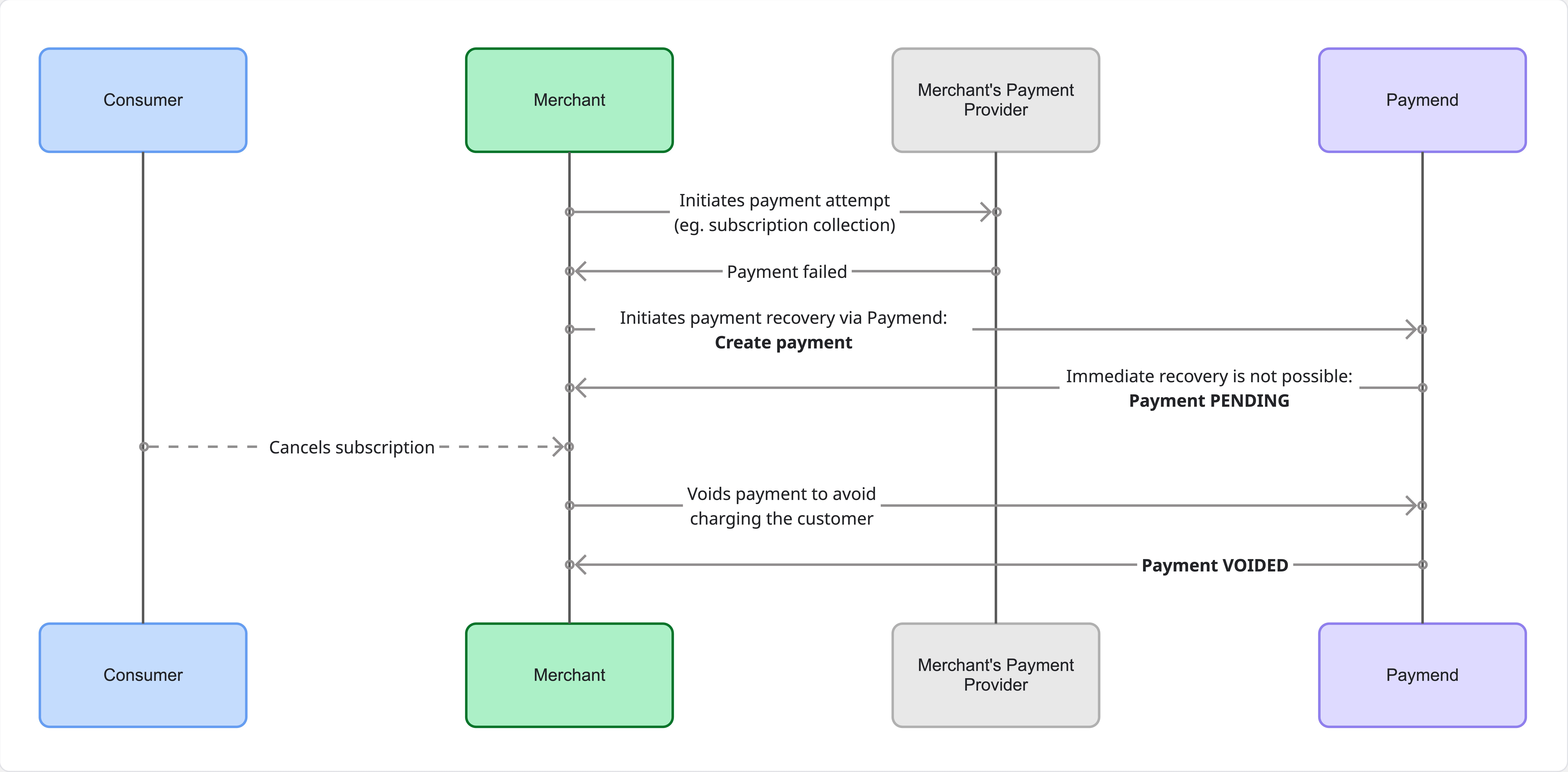
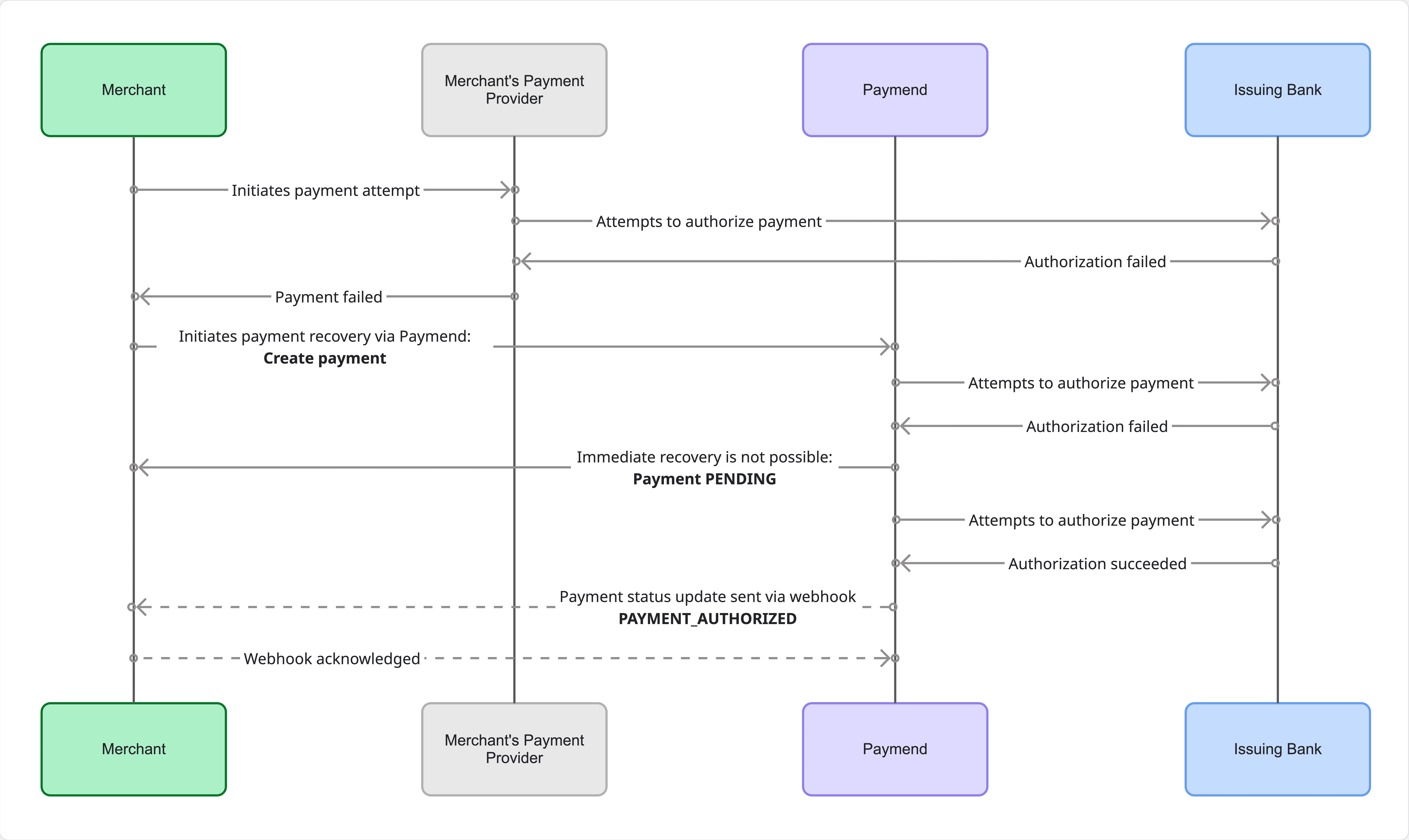
When Paymend requires additional time to process a payment, we respond to the payment creation request with a `PENDING` status.
A `PENDING` status means:
* The payment has been successfully created
* No final authorization decision has been made yet
* Paymend is actively managing recovery attempts
`PENDING` is always a temporary state. Without any further action from the merchant, the payment will eventually transition to one of the following final statuses:
* `AUTHORIZED`
* `CAPTURED`
* `FAILED`
Paymend will never hold a payment in a non-terminal state indefinitely: we enforce a maximum recovery window for all payments. If recovery is not successful within this window, the payment is marked as `FAILED` and no further attempts are made.
You can see the lifecycle for payments with Paymend [here](/core-concepts).
## Best practices for `PENDING` payments
While a payment is in `PENDING` state with Paymend, merchants may continue to attempt recovery outside of Paymend.
To avoid conflicts or double charges, please follow these rules:
1. **Do not retry the same payment via Paymend while it remains in `PENDING` state**.
2. If circumstances change such that no further authorization attempts should be made for a `PENDING` payment (for example, the order is canceled or the consumer is successfully charged elsewhere), **the payment with Paymend must be voided to prevent a double charge**.
In the event of a race condition where Paymend has already recovered the payment, resulting in a temporary double charge, you must issue a refund.
 ## Webhooks
Merchants should rely on Paymend webhooks to receive real-time notifications when a payment’s status changes (for example, when a payment moves from `PENDING` to `AUTHORIZED`). This avoids the need to poll the query endpoint for updates.
You can find more details on Paymend webhooks [here](/webhooks).
## Webhooks
Merchants should rely on Paymend webhooks to receive real-time notifications when a payment’s status changes (for example, when a payment moves from `PENDING` to `AUTHORIZED`). This avoids the need to poll the query endpoint for updates.
You can find more details on Paymend webhooks [here](/webhooks).
 ## Previous failure details
The more information you can provide about previous attempts to process a payment, the more effectively Paymend can recover it.
Paymend supports a [PreviousFailure](/api-reference/objects/previous-failure) object that allows you to pass details about earlier attempts and their failure reasons. This information helps route the payment onto the most effective recovery path more quickly.
## Integration checklist
To ensure your integration to Paymend is of the highest quality, ensure that you:
* Subscribe to webhooks (link to webhooks docs)
* Handle `PENDING` as a non-terminal state
* Void `PENDING` payments if no further authorization attempts should be made
* Provide [PreviousFailure](/api-reference/objects/previous-failure) data where available
## Previous failure details
The more information you can provide about previous attempts to process a payment, the more effectively Paymend can recover it.
Paymend supports a [PreviousFailure](/api-reference/objects/previous-failure) object that allows you to pass details about earlier attempts and their failure reasons. This information helps route the payment onto the most effective recovery path more quickly.
## Integration checklist
To ensure your integration to Paymend is of the highest quality, ensure that you:
* Subscribe to webhooks (link to webhooks docs)
* Handle `PENDING` as a non-terminal state
* Void `PENDING` payments if no further authorization attempts should be made
* Provide [PreviousFailure](/api-reference/objects/previous-failure) data where available